

Facelift Surgery in Turkey: What a Truly Skilled Surgeon Can Achieve
A great facelift is never about looking different. It is about looking like yourself again — only rested, restored, and entirely at ease.
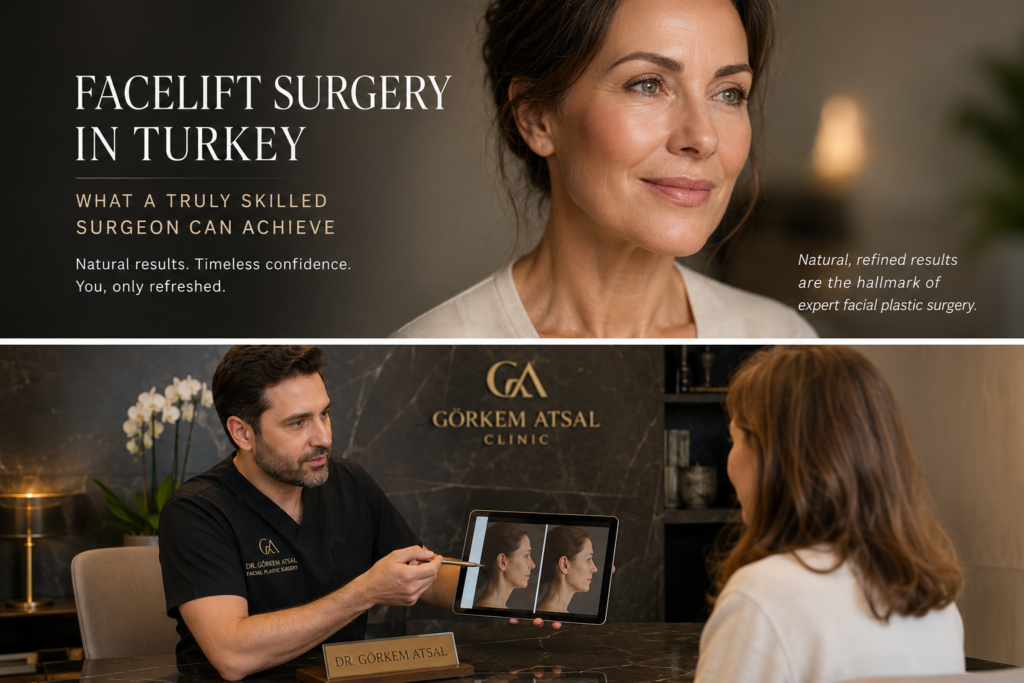
There is a particular kind of confidence that comes not from looking younger, but from looking like yourself — only rested, refined, and wholly at ease. This is the art of the modern facelift. Far removed from the stretched, wind-tunnel results that defined an earlier era of aesthetic surgery, today’s facelift — performed by an experienced facial plastic surgeon — restores the architecture of the face rather than simply pulling at its surface.
At Görkem Atsal Clinic in Istanbul, Dr. Görkem Atsal has built his reputation on precisely this philosophy: results that are natural, enduring, and entirely individual. For patients travelling from Europe, the Middle East, and beyond, facelift surgery in Turkey has become synonymous with world-class outcomes delivered in a setting of genuine luxury.
What Is a Facelift — and What Has Changed?
A facelift, known medically as a rhytidectomy, is a surgical procedure designed to address the visible signs of ageing in the mid-face, lower face, and neck. As we age, the underlying facial tissues descend, volume redistributes, and the skin loses its elasticity — producing jowls, deepened nasolabial folds, and a loss of definition along the jawline and neck.
The most significant advancement in modern facelift surgery is the shift toward deep-plane and SMAS-layer techniques. Rather than simply removing excess skin — the approach that produced those telltale tight, pulled results — a skilled facial plastic surgeon now repositions the deeper structural layers of the face. The skin, freed from tension, drapes naturally over a restored foundation.
The result is a face that looks genuinely refreshed, not surgically altered.
Deep Plane Facelift vs. Traditional Facelift
A traditional facelift addresses the skin and the superficial musculoaponeurotic system (SMAS) layer independently. A deep plane facelift releases the SMAS together with the overlying soft tissue as a single unit, allowing for more comprehensive repositioning — particularly in the midface and nasolabial region. Clinical evidence indicates that deep plane techniques offer greater longevity and more natural movement post-operatively, making them the preferred approach for many leading facial plastic surgeons today.
Who Is the Ideal Candidate for a Facelift?
The ideal candidate for facelift surgery is typically someone in their mid-forties to late sixties who has noticed meaningful changes to their facial contour — jowling, sagging along the midface, looseness in the neck — but retains reasonable skin quality and overall good health. That said, there is no single ideal age. Dr. Görkem Atsal evaluates each patient individually, taking into account facial anatomy, skin condition, bone structure, and personal aesthetic goals.
Patients who achieve the most satisfying outcomes are those with realistic expectations: they are not seeking to look like someone else, nor to recapture a face from twenty years ago. They want to look like the best version of themselves — and that is precisely what a well-executed facelift delivers.
Facelift surgery is not appropriate for those with significant uncontrolled medical conditions, active smoking habits that cannot be ceased pre-operatively, or unrealistic aesthetic expectations. A thorough consultation is essential before any decision is made.
What to Expect: The Facelift Process at Görkem Atsal Clinic
Initial Consultation
Every journey begins with a detailed, unhurried consultation with Dr. Görkem Atsal. This is far more than an assessment — it is a conversation. Your concerns, your goals, your facial anatomy, and your medical history are all carefully considered. Dr. Atsal will explain precisely which technique he recommends and why, what the realistic outcomes are, and what recovery will involve. There is no pressure, no sales process. Simply expert guidance.
Pre-Operative Preparation
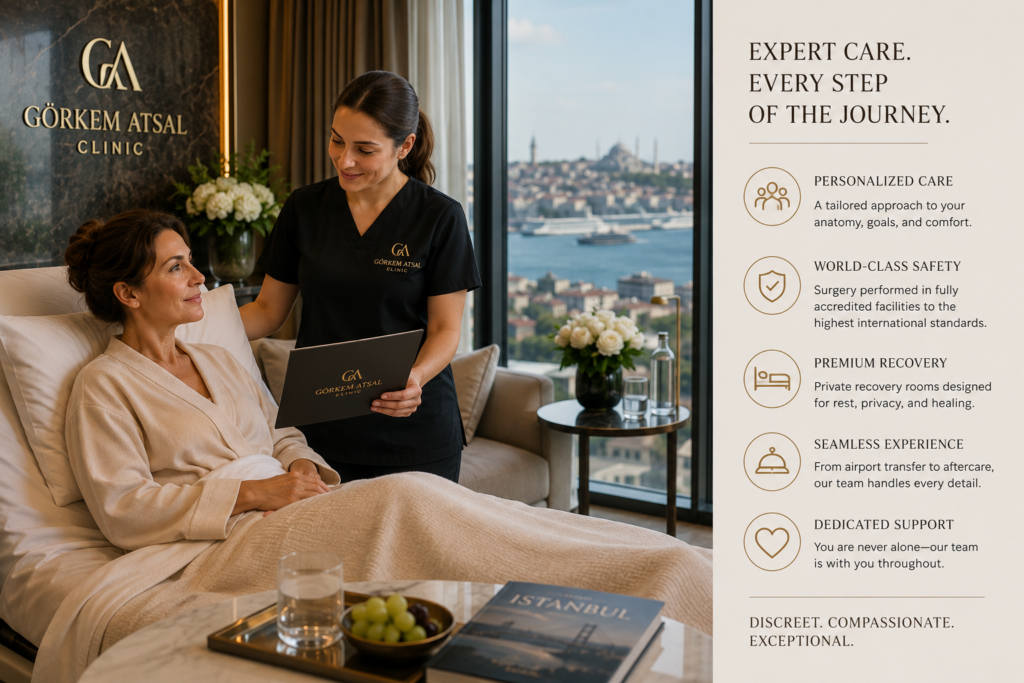
In the weeks before surgery, patients receive a comprehensive pre-operative protocol covering nutrition, medications to avoid, and skincare preparation. Smoking cessation is mandatory for a minimum period before and after surgery, as it significantly impairs wound healing. For international patients, the clinic’s patient coordination team handles every logistical detail — accommodation, transfers, and scheduling — ensuring the experience is seamless from the moment of arrival.
The Procedure
Facelift surgery at Görkem Atsal Clinic is performed under general anaesthesia in a fully accredited surgical facility. Depending on the technique and the extent of the procedure, surgery typically takes between three and five hours. Incisions are carefully placed within the natural contours of the ear and hairline, making scarring virtually imperceptible once healed.
Recovery
The initial recovery period involves swelling, bruising, and a degree of tightness — all entirely normal and temporary. Most patients feel socially presentable within two to three weeks, with the majority of swelling resolved by six weeks. Final results, however, continue to refine for up to twelve months as deeper tissues settle and scars mature. Patients are provided with a detailed post-operative care plan and have access to Dr. Atsal’s team throughout their recovery.
Results: What a Facelift Can — and Cannot — Do
A facelift addresses laxity, sagging, and loss of definition. It does not address skin texture, fine lines, pigmentation, or volume loss — though these concerns may be treated concurrently with procedures such as fat transfer, laser resurfacing, or injectables. Many patients choose to combine treatments for a more comprehensive rejuvenation, always guided by Dr. Atsal’s recommendations.
When performed with precision and artistry, a facelift produces results that are enduring — typically lasting a decade or more. Crucially, the face continues to age naturally after surgery; it simply does so from a more youthful baseline.
Why Choose Dr. Görkem Atsal for Your Facelift?
Facial plastic surgery demands a rare combination of technical precision, an artist’s eye, and a deeply considered understanding of facial anatomy. Dr. Görkem Atsal has devoted his career exclusively to facial aesthetics, accumulating expertise that is both broad and refined. His approach is unhurried and highly individualised — no two patients receive the same plan, because no two faces are the same.
Istanbul has emerged as one of the world’s foremost destinations for aesthetic surgery, attracting patients who seek internationally trained surgeons, state-of-the-art facilities, and a standard of care that matches or exceeds what is available in Western Europe or North America — often at a significantly more accessible cost. At Görkem Atsal Clinic, that premium experience is never compromised.
Frequently Asked Questions About Facelift Surgery
How long do facelift results last?
Results from a well-performed facelift typically last between eight and twelve years, though this varies depending on the technique used, the patient’s skin quality, lifestyle factors, and genetics. Deep plane techniques are generally associated with greater longevity than more superficial approaches. Maintaining a healthy lifestyle, sun protection, and a consistent skincare routine all support long-term outcomes.
Will a facelift leave visible scars?
In the hands of an experienced facial plastic surgeon, facelift scars are placed discreetly within the hairline and the natural folds around the ear. With proper post-operative care, they become virtually undetectable. Scar maturation takes up to twelve months, during which they fade significantly in both colour and texture.
Is it safe to have a facelift in Turkey?
Yes — provided you choose a board-certified, specialist facial plastic surgeon operating within an accredited facility. Dr. Görkem Atsal operates to the highest international surgical standards, and Görkem Atsal Clinic is equipped with advanced medical infrastructure. International patients are supported throughout their entire journey, from initial consultation to post-operative follow-up.
Can a facelift be combined with other procedures?
Absolutely. Many patients choose to combine a facelift with a neck lift, eyelid surgery, eyebrow lift, or fat transfer for a more harmonious overall result. Dr. Atsal will advise on which combinations are appropriate and safe based on your individual anatomy and goals.
What is the difference between a facelift and a mini facelift?
A mini facelift addresses early or mild laxity, primarily in the lower face and jowl area, using smaller incisions and less extensive tissue repositioning. It is suited to younger patients or those with more limited concerns. A full facelift — particularly a deep plane technique — addresses more advanced changes across the midface, lower face, and neck, delivering more comprehensive and longer-lasting results.
The Decision to Invest in Yourself
Choosing to undergo facelift surgery is a deeply personal decision — one that deserves careful thought, thorough research, and the right surgical partner. When performed by a skilled facial plastic surgeon like Dr. Görkem Atsal, a facelift is not about chasing youth. It is about restoring confidence, harmony, and a face that reflects the vitality you feel within.
For patients considering aesthetic surgery in Turkey, Görkem Atsal Clinic offers something rare: genuine surgical excellence within an environment of warmth, discretion, and uncompromising care.
